
Introduction
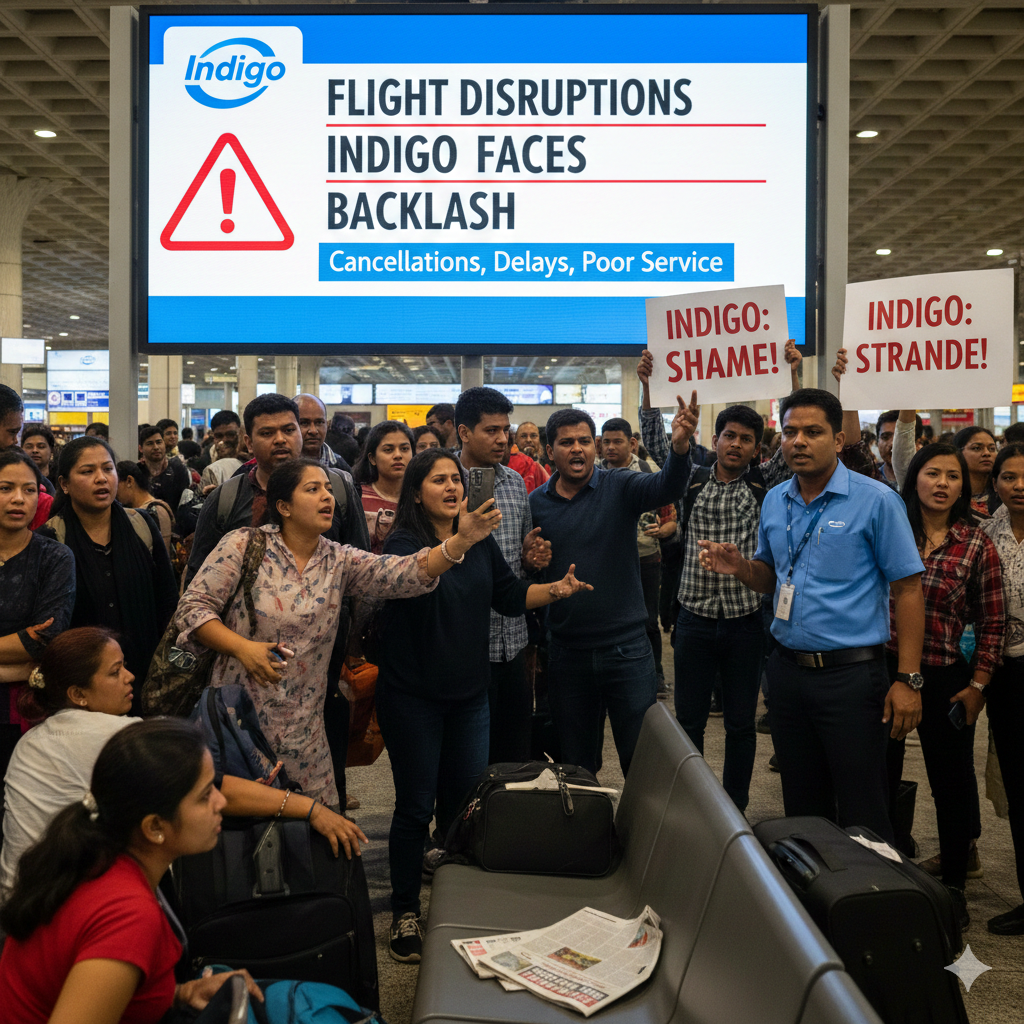
In early December 2025, India’s largest domestic airline, IndiGo, found itself at the epicenter of an aviation crisis — one that swiftly triggered public outrage, regulatory scrutiny, and widespread disruption of travel plans across the country. Once lauded for its punctuality and low-cost efficiency, IndiGo’s brand image has taken an abrupt hit as hundreds of flights were cancelled or delayed, leaving thousands of passengers stranded. As a digital marketing blogger and third-party observer, Digital Rajat Prasad dives into the unfolding saga to ask: what went wrong, why now, and what does this turmoil mean for IndiGo and Indian aviation at large?
The backlash matters because it’s not just about missed flights — it has exposed deeper structural and operational vulnerabilities in one of India’s most powerful carriers. It threatens consumer trust at a time when domestic air travel demand is surging. It also raises broader questions about airline preparedness, regulatory compliance, and industry resilience. With social media ablaze and government interventions already underway, this incident may well mark a turning point for how airlines operate and how passengers perceive them.
In this blog, we break down the full picture — from background and triggers to fallout, expert commentary, and what lies ahead for IndiGo and India’s aviation ecosystem.
Background: IndiGo’s Reputation & Past Challenges
IndiGo’s Rise and Brand Promise
IndiGo, over the years, has carved a position as India’s most reliable, efficient, and affordable airline. Known for its low-cost carrier (LCC) model, streamlined operations, and broad coverage of domestic routes, it captured a major share of domestic air traffic. For many passengers — middle-class travellers, frequent flyers, business travellers returning home, or students — IndiGo evoked trust, timely departures, and budget-friendly travel.
This success didn’t come from thin air. IndiGo built its reputation on razor-sharp cost efficiency, lean operations, quick turnarounds, and a fleet optimized for volume. Over time, it became the default choice for millions annually, especially on high-demand metro ↔ metro routes.
Recurring Customer Complaints & Soft Signals
Still, the trust wasn’t bulletproof. Even before 2025, there were recurring complaints from a significant subset of flyers. According to a recent survey, 54 % of passengers flagged issues like timeliness and staff behavior. Others reported concerns around baggage handling (42 %), delayed information (45 %), aircraft maintenance (27 %), and even on-board services like food or entertainment.
While these numbers never threatened IndiGo’s dominant position, they served as soft signals — warnings that efficiency-driven scale sometimes came at the cost of service quality and consistency.
Previous Operational/PR Challenges
Like many large airlines, IndiGo had weathered smaller-scale service disruptions, seasonal delays, and occasional customer grievances. Leasing decisions and fleet adjustments — such as past agreements with external partners — sometimes sparked controversy, but never on a scale that threatened the model itself.
In essence: before December 2025, IndiGo was already balancing tight margins, high volume, and rising customer expectations. The structure was in place. As we will see, what unfolded wasn’t a freak glitch — but a predictable collapse under stress.
What Exactly Happened — A Detailed Breakdown of the Incident
Trigger: New Crew Scheduling & Pilot-Duty Norms
In 2025, the Indian aviation regulator introduced stricter norms for pilot duty time and rest under the regulatory framework of DGCA (Directorate General of Civil Aviation). Pilots now require increased rest intervals, limitations on night landings, and stricter maximum duty hours to combat fatigue. These rules, designed to bolster safety standards, came into effect in phases — with full implementation reaching airlines like IndiGo by 1 November 2025.
For airlines with lean staffing models, this was a major structural shift. IndiGo — which structured operations around high-frequency flights and tight crew scheduling — was particularly vulnerable. The new rest-time requirements significantly reduced available crew-hours per pilot, meaning many previously planned flights could no longer be staffed under old rosters.
Poor Preparation + Scheduling Gaps = Chaos
Critically, it appears IndiGo underestimated the impact of these rules, or failed to plan adequate buffer staffing. When the new norms kicked in, the airline discovered it had insufficient pilots and crew to cover its schedule, especially during peak demand periods. As a result, a cascading failure began:
- Flights scheduled under old roster plans no longer met regulatory crew-rest compliance.
- Subsequent delays and cancellations disrupted aircraft utilization.
- Parking bays and gates remained tied up as aircraft waited for crew, triggering bottlenecks.
- As days progressed, cancellations snowballed — affecting hundreds of flights daily, across multiple hubs: Delhi, Mumbai, Bengaluru, Hyderabad, Kolkata and more.
By December 4–5, 2025, the disruption had escalated into a full-blown crisis. Estimates of cancelled or delayed flights ranged into the hundreds — even crossing 1,000 flights cancelled in a single day at the peak of the mess.
Official Admission & Apology
Faced with mounting backlash and regulatory pressure, IndiGo admitted that scheduling and crew-planning failures — rather than just external factors — were the root cause. The airline issued a public apology acknowledging “significant operational disruption” and promising refunds or alternate flight options for affected customers.
The airline also sought an exemption from certain night-duty norms, asking the regulator for temporary relief while it rejigs its crew roster and hiring plans.
The Public Backlash: Voices, Sentiments, and Social Media Outrage
Passenger Complaints — Frustration Hits Social Media
Social media platforms — especially X (formerly Twitter) — erupted with frustrated passengers airing their grievances. Common complaints included:
- Flights cancelled without prior notice.
- Standing in airport queues for 10–12+ hours with no clarity on rebooking or refund.
- Poor communication and lack of staff presence at check-in counters or boarding gates.
- Additional expenses incurred — cab rides, food stays, missed meetings, personal commitments — with no compensation.
One typical social-media post summed up the frustration:
“My IndiGo flight from Pune to Delhi delayed by over 3.5 hours. I’ve been waiting 12 hours at the airport — no information, nothing.”
Another labelled the situation an “absolute mockery of airline management and passenger rights.”
Widespread Anger — Brand Reputation Takes a Hit
For many customers, what made the situation worse than a delay or cancellation was the complete breakdown of trust. IndiGo — long regarded as dependable and punctual — suddenly became a textbook example of mismanagement. Some travellers swore they would never fly with IndiGo again. Others warned potential flyers on social media to avoid booking with the airline until clarity returned.
Regulatory & Government Pressure
As outrage mounted, government agencies stepped in. The civil aviation ministry and DGCA launched an urgent review of IndiGo’s operations. IndiGo was directed to submit a “comprehensive roadmap” aligning crew recruitment and aircraft induction with regulatory compliance.
The government also ordered IndiGo to process all refunds for affected passengers by December 7, 2025, and barred imposition of rescheduling fees for disrupted travellers.
In short: what began as an operational misstep transformed into a full-blown public-relations and regulatory crisis.
Industry & Expert Reactions
Aviation Analysts & Safety Advocates: A Sign of Structural Weakness
Many industry experts and aviation analysts have called the IndiGo crisis a wake-up call for the entire Indian aviation sector. According to them:
- The newly enforced duty-time and rest norms (meant to curb pilot fatigue) were mandatory and known well in advance. The scale of disruption suggests a failure in long-term crew planning and risk management.
- Lean business models, while cost-efficient, leave little buffer for error — meaning any shift in regulation, demand, or schedule triggers instability.
- For safety-conscious regulators and industry stakeholders, the collapse raises red flags — especially if airlines scale too fast without matching growth in crew strength and support infrastructure.
As one expert put it: “This isn’t just a scheduling failure — it’s a structural flaw in over-relying on minimal buffers for maximum output.” (paraphrased from multiple expert commentaries)
Customer-Experience & Brand Management Professionals: Reputation Fallout is Real
For brand reputation analysts and customer-experience consultants, the crisis is a textbook case of how operational failures can erode brand equity — often faster than good times build it up. Key concerns:
- Customer trust, once lost, is hard to regain. Even after normalcy returns, many passengers may switch permanently to competitor airlines.
- Poor communication — delayed status updates, lack of staff support, vague reasons — amplifies frustration. In the age of social media, every upset passenger becomes a brand critic on X, Instagram, or LinkedIn.
- IndiGo’s lack of contingency planning (hotels, alternative flights, compensation) will haunt its brand narrative for months, if not years.
Overall, experts warn that the cost — in brand goodwill and long-term loyalty — may outweigh short-term operational savings.
Why This Backlash Matters: Beyond Just Missed Flights
Erosion of Brand Image & Passenger Trust
IndiGo’s brand was built on reliability, affordability, and broad coverage. The December 2025 disruptions shattered that image overnight. For many passengers — especially business travellers, families, students — this wasn’t just an inconvenience: it was a breach of trust. The “once-go-to airline” for domestic travel is now viewed as unpredictable and unreliable.
Given the frequency and scale of the chaos, this could lead to a permanent shift in traveller behaviour — especially among those with flexible budgets who can afford airlines with more stable service (or better customer support).
Market Competition Gets Sharper
IndiGo’s dominance means that when it falters, a sizable portion of India’s domestic air traffic is affected. But this also opens a window for rival carriers — established or emerging — such as Air India, Vistara, SpiceJet, Akasa Air and others to siphon away dissatisfied customers.
Passengers seeking reliability and better customer service may shift loyalty — especially if competitors build trust during this turbulence. For IndiGo, this means potential market-share loss, revenue dip, and heightened pressure to restore service excellence.
Long-Term Business & Operational Risks
The crisis exposes deeper systemic risks for lean-model airlines operating in highly regulated, high-demand environments:
- Over-dependence on just-in-time crew scheduling leaves no margin for error.
- Regulatory changes — especially those aimed at safety — can become existential threats if not planned for proactively.
- Reputation damage cascades: once negative sentiment spreads widely, attracting new customers gets harder, and retaining existing ones becomes difficult.
In the long run, such crises could force airlines to reconsider their business models — possibly moving toward less aggressive scheduling, bigger crew rosters, or more conservative growth strategies.
What This Means for Indian Aviation — Bigger Picture Implications
Regulatory and Policy Changes — Safety vs. Volume
The tighter pilot rest and duty-time rules introduced by DGCA were aimed at improving safety and reducing pilot fatigue. That remains a valid and vital objective. However, the IndiGo collapse shows that safety regulations must be paired with robust planning, not last-minute adjustments.
Regulators may now enforce stricter compliance checks, crew-to-flight ratio requirements, mandatory buffer staffing levels, and contingency planning for airlines. This could lead to industry-wide restructuring — and possibly higher operational costs, which may reflect in ticket prices.
Customer Service Expectations Will Rise
The IndiGo crisis has reset passenger expectations. Travellers are unlikely to accept vague explanations or empty apologies. They will demand transparent communication, timely updates, contingency support (refunds, alternate flights, accommodations), and better on-ground assistance during disruptions.
Airlines ignoring this shift may struggle to regain public confidence.
Social Media’s Role: Amplifier + Accountability Tool
This situation underscores the power of social media. Passengers documenting their ordeal — tweets, photos of crowded airport halls, long queues, missed meetings — played a crucial role in magnifying the backlash.
Moving forward, airlines will have to treat online sentiment not as noise, but as a critical part of reputation management. Real-time social listening, response mechanisms, and proactive customer support will become non-negotiable parts of operational strategy.
A Shift in Industry Dynamics
For an industry long driven by low-cost carriers and high-frequency scheduling, this may signal a pivot point. We could see a trend where airlines balance frequency with stability — investing more in crew strength, infrastructure, and customer service.
Smaller or more conservative carriers may gain an edge, while aggressive growth strategies may lose favour — potentially reshaping India’s domestic aviation landscape for years to come.
IndiGo’s Path Forward: What Needs to Happen Next
Immediate Actions — Regain Ground and Trust
- Transparent Communication & Remediation
IndiGo must continue to publicly acknowledge failures, provide clear timelines for restoration, and communicate with affected customers proactively. Refunds, rebooking support, and no rescheduling fees are essential. The mandate by the government to clear refunds by 7 December 2025 must be followed strictly. - Customer Support & Compensation
Offering not just refunds but goodwill gestures — e.g., discount vouchers, priority booking, compensation for major inconveniences — will help placate upset flyers and salvage brand goodwill. - Crew Hiring & Roster Overhaul
Expand pilot and crew rosters to meet new regulatory norms without overburdening staff. Build buffer crew strength to handle contingencies. - Operational Transparency
Publish a clear recovery plan showing how IndiGo intends to meet demand while honoring rest-time rules, avoid over-scheduling, and prevent future cancellations.
Medium to Long Term — Rebuild Reputation & Safeguard Brand Equity
- Review Business Model: Shift from an aggressive high-frequency, minimal-buffer scheduling model to a more resilient structure with built-in slack.
- Strengthen Crisis-Management Infrastructure: Real-time passenger communication, emergency support teams, alternate travel partners, better handling of cancellations and delays.
- Invest in Customer Experience: Staff training, improved on-ground support, timely baggage handling, and better information systems.
- Engage Stakeholders & Regulators: Work proactively with DGCA, civil aviation ministry, airports to ensure compliance and improved passenger safety & comfort.
- Public Relations & Brand Restoration Campaign: Use transparency, customer testimonials, honest communication to slowly rebuild trust, perhaps via social media engagement and open feedback channels.
Conclusion: The Significance of This Crisis — from One Blogger’s Lens
As Digital Rajat Prasad, a digital marketing blogger and neutral observer, I see the 2025 IndiGo crisis not just as a service breakdown — but as a cautionary tale for scaling too aggressively without adequate systemic safeguards.
IndiGo’s success was always underpinned by efficiency, cost-leadership, and volume. But when regulatory dynamics changed — with valid safety-focused rules — the airline’s structural rigidity proved its undoing. The result: thousands of stranded passengers, broken trust, and a brand that now carries a stain.
This backlash matters because it signals a shift in what Indian flyers expect from airlines. No longer is low cost enough. Reliability, transparency, customer support, and passenger rights have taken center stage. Airlines ignoring this will do so at their peril.
For Indian aviation as a whole, the lesson is clear: growth must be balanced with resilience. Safety regulations aren’t roadblocks — they are guardrails. And in a sector where pressure to deliver volume is high, the real winners will be those who recognize that passengers are not just ticket-numbers — they are brand ambassadors, critics, and ultimately the judges of credibility.
As for IndiGo, this is a moment of reckoning. How they respond — in the next weeks and months — will define whether they remain India’s default carrier, or become a cautionary example of what happens when ambition outpaces responsibility.
Frequently Asked Questions (FAQs)
Q1: Why did IndiGo cancel so many flights in December 2025?
A: The cancellations were triggered by new crew duty-time and rest norms introduced by DGCA, coupled with IndiGo’s lack of preparedness — insufficient pilot and crew numbers to meet tighter rest requirements. This caused scheduling chaos and mass cancellations.
Q2: Is this problem unique to IndiGo?
A: While the new norms apply across Indian aviation, the impact was disproportionately high on IndiGo due to its lean staffing model and high-frequency scheduling. Other airlines with larger buffer staff or conservative scheduling fared better.
Q3: Are passengers entitled to refunds or compensation?
A: Yes. The Ministry of Civil Aviation has directed IndiGo to clear all pending refunds by December 7, 2025, and barred the airline from charging rescheduling fees for affected passengers.
Q4: What should passengers do if their flight is cancelled?
A: Contact IndiGo’s support immediately for a refund or alternate flight. Photograph queue conditions or communication breakdowns. If delays continue beyond reasonable time, consider alternate airlines or modes of travel depending on urgency.
Q5: Will this affect airfares in the short term?
A: Yes. The cancellations and reduced capacity have already caused a surge in ticket prices — some fares on busy routes increased by 2–5 times during the disruption.
Q6: Does this incident raise safety concerns?
A: The new duty-time rules were introduced to improve safety by reducing pilot fatigue. The problem here wasn’t the rules themselves but poor roster planning. However, the sudden rule rollback (or exemptions) — if mishandled — could compromise the safety objective.
Q7: Can IndiGo regain customer trust after this fiasco?
A: It’s possible — but will require transparent communication, operational stability, better customer support, and consistent service for an extended period. One apology alone won’t be enough; sustained corrective action will matter.
Q8: What does this mean for Indian aviation’s future?
A: The crisis could prompt distributors to rethink growth strategies. Expect more conservative scheduling, increased crew recruitment, higher emphasis on safety and customer experience, and possibly higher fares to accommodate structural costs.
Q9: Are stricter regulations coming for all airlines now?
A: Regulators may tighten compliance checks and mandate minimum crew-to-flight ratios or buffer staffing to prevent similar disruptions. Airlines might also be required to maintain contingency plans or face stricter oversight.
Q10: Should travelers avoid booking with IndiGo for now?
A: If your travel dates and plans are flexible, you might consider alternate airlines to avoid risk. If time-sensitive — weigh the cost vs. risk carefully, and ensure you have fallback plans.
If you like, I can extend this blog with data-driven charts (e.g. number of cancelled flights over time, passenger sentiment analysis) and social-media reaction snapshots to make it more visual and comprehensive.