
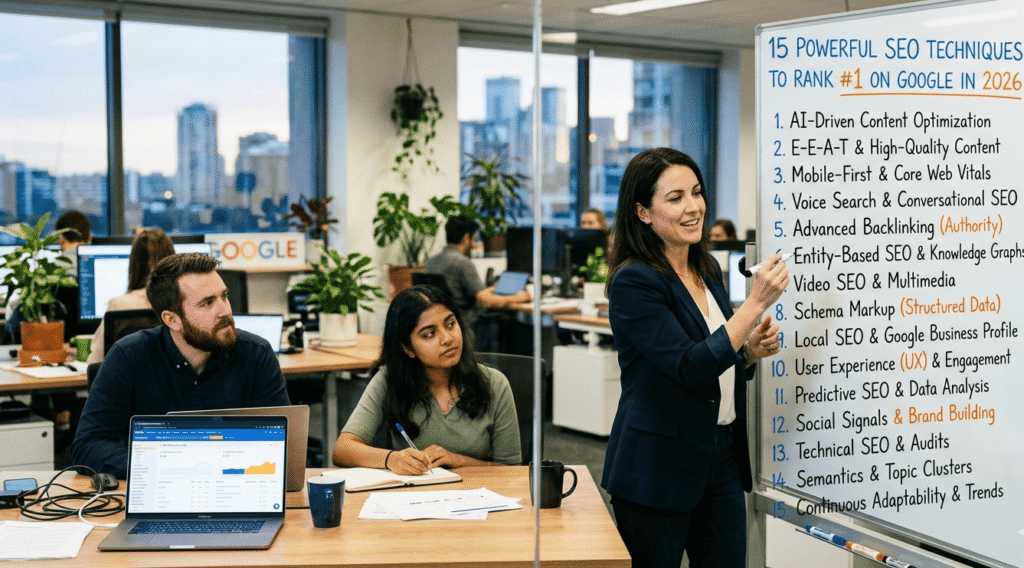
Introduction: Why Your SEO Isn’t Working Anymore
Let’s be honest—SEO today doesn’t look anything like it did even two years ago.
You can write a “perfect” blog, sprinkle keywords, build a few backlinks… and still struggle to rank. Frustrating, right?
That’s because Google in 2026 isn’t just ranking content—it’s ranking experience, intent, and trust.
The good news? If you understand what actually works now, you can outrank competitors—even bigger ones.
This guide breaks down 15 powerful SEO techniques for 2026 that are not just trends—they’re the new rules of the game.
Table of Contents
- Search Intent Optimization
- Build Topical Authority
- EEAT is Non-Negotiable
- AI + Human Content Strategy
- Zero-Click SEO Optimization
- Voice Search Optimization
- Programmatic SEO
- Content Depth Over Length
- Internal Linking Strategy
- User Experience (UX) Signals
- Featured Snippets Optimization
- Semantic SEO & Entities
- Content Refresh Strategy
- Personal Branding for SEO
- High-Quality Backlinks (Still Matter)
1. Search Intent Optimization
What it is:
Understanding why a user is searching—not just what they’re searching.
Why it matters in 2026:
Google’s algorithm now prioritizes intent satisfaction over keyword matching.
How to implement:
- Analyze top 10 results for your keyword
- Identify intent: Informational, transactional, navigational
- Match your content format accordingly
Example:
Searching “best SEO tools” = listicle, not a long essay.
Pro Tip: If your content doesn’t match intent, it won’t rank—no matter how good it is.
2. Build Topical Authority
What it is:
Owning an entire topic, not just one keyword.
Why it matters:
Google trusts websites that cover a topic in-depth.
How to implement:
- Create content clusters
- Interlink related blogs
- Cover beginner → advanced topics
💡 Example cluster:
- SEO Basics
- On-page SEO
- Technical SEO
- SEO Tools
Internal Link Suggestion: [Read our complete SEO guide]
3. EEAT is Non-Negotiable
(Experience, Expertise, Authority, Trust)
Why it matters:
Google now prioritizes real experience over generic content.
How to implement:
- Add author bio with expertise
- Include real examples/screenshots
- Show proof (case studies, results)
💡 Pro Tip: Write like someone who has done the work, not just read about it.
4. AI + Human Content Strategy
What it is:
Using AI for speed, humans for depth.
Why it matters:
AI content is everywhere. Only human-enhanced content wins.
How to implement:
- Use AI for outlines and drafts
- Add personal insights, opinions, storytelling
- Edit for tone and clarity
💡 Opinion: Pure AI content is the fastest way to stay average.
5. Zero-Click SEO Optimization
What it is:
Optimizing content to appear in featured snippets, knowledge panels.
Why it matters:
Users often don’t click—they get answers directly.
How to implement:
- Use clear definitions
- Add bullet points
- Answer questions directly
6. Voice Search Optimization
What it is:
Optimizing for conversational queries.
Why it matters:
Voice searches are growing rapidly.
How to implement:
- Target long-tail keywords
- Use natural language
- Add FAQ sections
Example:
Instead of “SEO tips” → “What are the best SEO tips in 2026?”
7. Programmatic SEO
What it is:
Creating multiple pages using templates + data.
Why it matters:
Helps scale content fast.
How to implement:
- Use structured templates
- Target location-based or niche keywords
- Automate content generation carefully
8. Content Depth Over Length
What it is:
Quality > quantity.
Why it matters:
Google values complete answers, not long articles.
How to implement:
- Cover topic fully
- Avoid fluff
- Add actionable steps
💡 Short but useful beats long and boring.
9. Smart Internal Linking
What it is:
Connecting your pages strategically.
Why it matters:
Helps Google understand your site structure.
How to implement:
- Link relevant pages
- Use keyword-rich anchor text
- Avoid over-linking
10. User Experience (UX) Signals
What it is:
How users interact with your site.
Why it matters:
Google tracks:
- Bounce rate
- Time on page
- Engagement
How to improve:
- Fast loading speed
- Mobile-friendly design
- Clean layout
11. Featured Snippets Optimization
What it is:
Ranking in position #0.
How to implement:
- Use question-based headings
- Answer in 40–60 words
- Use lists and tables
12. Semantic SEO & Context
What it is:
Using related keywords and concepts.
Why it matters:
Google understands context, not just keywords.
How to implement:
- Use synonyms
- Add related topics
- Write naturally
13. Content Refresh Strategy
What it is:
Updating old content.
Why it matters:
Fresh content ranks better.
How to implement:
- Update stats
- Improve structure
- Add new insights
💡 Pro Tip: Updating old blogs = fastest SEO win.
14. Personal Branding for SEO
What it is:
Building authority as a person.
Why it matters:
People trust people, not websites.
How to implement:
- Be active on LinkedIn
- Share insights
- Build audience
15. High-Quality Backlinks (Still Matter)
What it is:
Links from trusted websites.
Why it matters:
Still one of Google’s strongest ranking signals.
How to implement:
- Guest posting
- Build relationships
- Create link-worthy content
👉 External Link Suggestion: Refer to industry leaders like Moz, Ahrefs, Search Engine Journal
Mini Case Study
A small blog focused only on topical authority + internal linking grew from 0 to 50K traffic in 6 months.
No aggressive backlinks.
No tricks.
Just consistent, valuable content + smart SEO structure.
That’s how powerful modern SEO is.
Conclusion: What Actually Works in 2026
SEO in 2026 is not about hacks—it’s about helping users better than anyone else.
Key Takeaways:
- Focus on intent, not keywords
- Build authority, not just articles
- Combine AI with human insight
- Prioritize experience and trust
👉 If you apply even 5–6 of these techniques consistently, ranking #1 is no longer luck—it’s strategy.
Call to Action
If you’re serious about growing in digital marketing, don’t just read—implement.
Start with one technique today.
Then build momentum.
Because in SEO, consistency beats everything.
FAQs
1. What are the best SEO techniques in 2026?
The best techniques include search intent optimisation, EEAT, topical authority, and AI-assisted content strategies.
2. Is SEO still relevant in 2026?
Yes, but it has evolved. It now focuses more on user experience, trust, and content quality.
3. How long does SEO take to show results?
Typically 3–6 months, depending on competition and consistency.
4. Does AI content rank on Google?
Yes, but only when enhanced with human insights and value.
5. What is the most important SEO factor?
Search intent and content relevance are the most critical factors today.